Thursday, December 6, 2012

Some amazing Greenspan quotes

Some amazing Greenspan quotes:
"Reducing U.S. long-term deficits will inevitably cause economic pain."
“The presumption that we’re going to have a painless solution to this, I think, is fantasy. There are a lot of risks out there but the one thing I can be reasonably certain of is we won’t get through this whole issue without some pain.”
“A credible framework to set federal fiscal policy on a stable path -- for example, one on which the ratio of federal debt to GDP eventually stabilizes or declines -- is thus urgently needed to ensure longer-term economic growth and stability”
…the “key part” of the deficit is“government social benefits to persons.”
“Two percent is going to be our normal for now. “What is going to be the key factors in the long-term productivity outlook is innovation. I think there are types of things out there we can have no insight into.”
(during his tenure as Fed chairman one of his main tenants of 'why' we could continue with the growth levels that were being experienced was due to the 'new paradigm' of productivity gains - that did not quite pan out!....so here he is right back pushing productivity as the key yet having no idea where that might come from!)
December 2012

Greek debt skyrockets...

This looks like a problem with no end...an amazing trajectory, circular issues (controling costs while attemtping to generate improved levels of GDP) - does this have a foreseeable ending that works out for anyone's good?
 

debt, debt and more debt...


As you take a look at the following graphic representations of the debt of our country the first question that comes to my mind is - where is this headed?  And at what warp speed? 

I thought that we learned during the last two economic meltdowns that too much debt is ALWAYS a bad thing for everyone involved. Yet, our fearless leaders continue to take us down the path of more debt (or maybe it's just the course of least resistance - it's very hard to draw the line and say NO!) a band aid here and an increase in the debt ceiling there but never, ever cut spending. But at some point the party ends and not very many people go home with party favors worth having…

 
US Total Federal Debt - talk about a fiscal cliff in reverse this trend looks better than an F 15's takeoff trajectory….
 
 
US Federal Debt as a % of GDP - at least we are not at Greece's level of 180% but we try harder!

Monday, December 3, 2012

revised 3rd qtr GDP


U.S. GDP growth accelerated to 2.7% in the third quarter, supported by a rise in government spending.

GDP for 3Q was revised from 2.0% to 2.7%, a much more palatable rate of growth. However, the details of the report were not as exciting. The revision included:

            - a drop in personal consumption from 2.0% to 1.4%,

            - a drop in the savings rate from 3.7% to 3.6%,

            - and weaker personal income.

Inventories were the real story behind the upward revision, initially subtracting 0.1% from GDP and now adding 0.8%. This is not necessarily a good thing for 4Q because that build-up will have to be given back.

Federal government spending was up 9.5% and total government spending (including state and local) was up 3.5%, also boosting the headline growth rate. That jump in government spending is also unlikely to be replicated. 

Wednesday, November 28, 2012

Some interesting trends reflected in changes to consumer debt components. And mortgage debt continues its decline with refinancing generating a significant part of recent mortgage activity volume.
Will these trends be the ‘new normal’ for an extended period of time?
On the other hand, government debt continues to climb at record speed with no end in sight!
 
In the Fed report on household debt released yesterday, mortgage debt fell $120b, equity lines of credit shrank $16b, student loan debt rose $42b, auto loans rose $18b, and credit card balances rose $2b. As mortgage debt drops (through a combination of pay downs and defaults), student loans and auto debt is taking some of its place which will likely be an issue down the road. The Market Today ONLINE
Falling Mortgage Balances Offset Rising Student, Auto, Credit-Card Debt
By Josh Mitchell
Americans cut their debt further in the summer, with falling mortgage balances more than offsetting increases in other types of borrowing, new data show.
 
Household debt — the money Americans owe on home, auto and student loans, credit cards and other types of consumer debt — fell by $74 billion in the third quarter to $11.31 trillion as of Sept. 30, the Federal Reserve Bank of New York said Tuesday.The drop reflected a continued decline in mortgage debt, as some households paid down balances while others lost their homes in foreclosure.
Americans have reduced their debts by more than $2 trillion since household debt peaked in summer 2008, a process called deleveraging. Economists saythe process will put households on a sounder financial footing in the long term, though it has sapped consumer spending and slowed growth in the short term.
Some additional information regarding delinquency trends for credit cards and student loans: the fastest growing consumer loan component now has the highest level of delinquency.


Wednesday, November 14, 2012

retail sales and personal consumption

So, where is GDP headed? Where is the trend line leading us...

Saturday, November 3, 2012

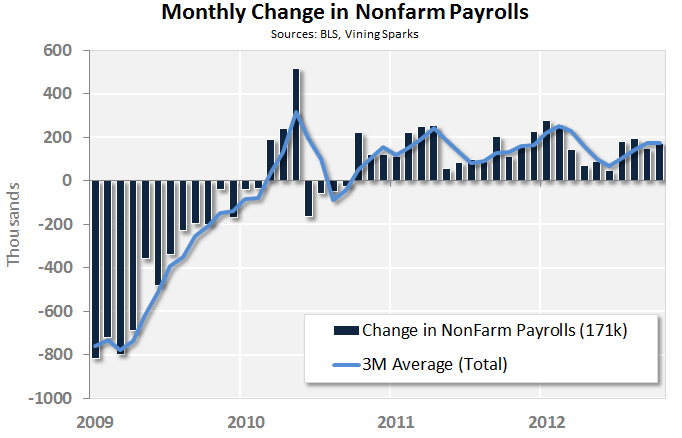
jobs roller coaster

Looks like a roller coaster to me! When does the ride end?
Or maybe the better question is - how long do we have to deal with the ‘new normal’!