Sunday, January 4, 2015

The Depression That Was Fixed by Doing Nothing

The often forgotten 1920-21 economic crisis suggests that sometimes the best stimulus is none at all.


(for your pondering enjoyment.....and something to think about as we continue to slide (are aggressively pushed!) into more and more government involvement in our daily lives...)


By James Grant


To combat the Great Recession and its long-lingering aftermath, leading central banks have pulled some $10 trillion out of thin air. Governments of the world’s principal economies have rung up almost $20 trillion in deficit spending. We often hear that the authorities have done too little. Perhaps they have done too much.
Not so long ago, the authorities did hardly anything. In response to the severe, little-known economic slump of the early 1920s, they virtually sat on their hands. It is an often forgotten episode that suggests the potential for constructive federal inaction—and underscores the healing power of Adam Smith ’s invisible hand.
Beginning in January 1920, something much worse than a recession blighted the world. The U.S. suffered the steepest plunge in wholesale prices in its history (not even eclipsed by the Great Depression), as well as a 31.6% drop in industrial production and a 46.6% fall in the Dow Jones Industrial Average. Unemployment spiked, and corporate profits plunged.
What to do? “Nothing” was the substantive response of the successive administrations of Woodrow Wilson and Warren G. Harding. Well, not quite nothing. Rather, they did what few 21st-century policy makers would have dared: They balanced the federal budget and—via the still wet-behind-the-ears Federal Reserve—raised interest rates rather than lowering them. Curiously, the depression ran its course. Eighteen months elapsed from business-cycle peak to business-cycle trough—following which the 1920s roared.
The adage that “the past is a foreign country” is especially apt in economics. In 1920, “macroeconomics” had yet to be invented. People spoke of prosperity and depression but not of a national economy. Still less did they identify an organic whole for the government to manage. Intervention came later; by 1929, central bankers had begun to dabble in the technique of price-level “stabilization.” After the crash, President Herbert Hoover famously pressed employers not to cut wages.Laissez faire had its last hurrah in 1921. In the 1920 Republican Party platform, the only comment on “national economy” had to do with the stewardship of the federal finances.
Borrowing and interest-rate suppression during World War I had fostered a postwar boom. Imbibing the inflationary ether, Harry Truman, then in his mid-30s, opened a new haberdashery in Kansas City. General Motorsbuilt the world’s largest headquarters building in Detroit. National City Bank , forerunner to today’s Citibank , overexpanded in Cuba.
The sky took its time in falling. A belated monetary tightening compounded the hardship of plunging prices—a combination that battered bankers, laborers, farmers, corporate titans and small businesspeople alike. By the close of 1920, Billy Durant, the flamboyant chief of GM, was broke and jobless. A year and a half later, the future 33rd president of the U.S. and his haberdashery partner were out of business, and the mighty City Bank was nursing its self-inflicted wounds in Cuba.
All this made 1921 a grim time. There had been a flu pandemic and a Red Scare. Labor and management were at each other’s throats. Prohibition had closed the bars and taverns (or driven them underground). Someone had fixed the 1919 World Series. And the Federal Reserve, determined to protect the purchasing power of the gold dollar, actually raised interest rates in the face of collapsing business activity—to as much as 8% in 1920. Without a federal safety net, people got by on savings, wits or charity—or they didn’t get by.
In the absence of anything resembling government stimulus, a modern economist may wonder how the depression of 1920-21 ever ended. Oddly enough, deflation turned out to be a tonic. Prices—and, critically, wages too—were allowed to fall, and they fell far enough to entice consumers, employers and investors to part with their money. Europeans, noticing that America was on the bargain counter, shipped their gold across the Atlantic, where it swelled the depression-shrunken U.S. money supply. Shares of profitable and well-financed American companies changed hands at giveaway valuations.
Of course, the year-and-a-half depression must have seemed interminable for all who were jobless or destitute. It was, however, a great deal shorter than the 43 months of the Great Depression of 1929-33. Then too, the 1922 recovery would bring tears of envy to today’s central bankers and policy makers: Passenger-car production shot up by 63%, for instance, and the Dow jumped by 21.5%. “From practically all angles,” this newspaper judged in a New Year’s Day 1923 retrospective, “1922 can be recorded as the renaissance of prosperity.”
In 2008, as Lehman Brothers toppled, the Great Depression monopolized the market on historical analogies. To avoid a recurrence of the 1930s, officials declared, the U.S. had to knock down interest rates, manipulate stock prices to go higher, repave the highways and trade in the clunkers.
The forgotten depression teaches a very different lesson. Sometimes the best stimulus is none at all.
—Mr. Grant is the author of “The Forgotten Depression: 1921: The Crash That Cured Itself.”
http://www.wsj.com/articles/the-depression-that-was-fixed-by-doing-nothing-1420212315?mod=WSJ_hp_RightTopStories

Tuesday, December 30, 2014


more and more government intervention means less and less freedom and economic progress.....

but the 'progressives' (ie: socialists et al) believe just the opposite, yet they do not look at the reality of their 'thinking'.....and the actual real-life results of their so called progressive agenda: less freedom and liberty!


What's the Best Country for Business?

December 30, 2014
Forbes recently released its list of the best countries for business, and the United States has found itself far down the list. Kurt Badenhausen reports that America fell four spots this year, dropping to 18th place. While the country was second on the list in 2009, it has declined every year since.
Why the decline? Badenhausen offers a number of reasons:
  • The U.S. government has expanded in size, bringing with it a host of new regulations in the health care and finance industries.
  • Since 2009, there have been 130 new major federal regulations for starting businesses, costing $60 billion annually.
  • For seven years in a row, the United States has dropped in the "economic freedom" rankings, as compiled by the Heritage Foundation, and its "monetary freedom" ranking is eighty-first out of 146 countries.
  • America's corporate tax rates are the highest in the developed world, and the tax system is incredibly complex. The World Bank ranks the U.S. corporate tax system forty-third among 146 nations.
Which nation topped the Forbes list? Denmark. Badenhausen explains that its few regulations make it easy -- and relatively inexpensive -- to start new businesses in the country. Following Denmark and rounding out the top 10 were Hong Kong, New Zealand, Ireland, Sweden, Canada, Norway, Singapore, Switzerland and Finland.
Source: Kurt Badenhausen, "U.S. Slides Again As Denmark Tops Forbes' Best Countries For Business," Forbes.com, December 17, 2014.

Tuesday, November 18, 2014

proliferation of laws, rules, and regulations...

Liberty and freedom require effort, sacrifice, honor and a people with a strong moral character.

“Only a virtuous people are capable of freedom. As nations become more corrupt and vicious, they have more need of masters.”-Benjamin Franklin
Historian Tacitus noted, as Rome became more and more corrupt, the number of laws grew rapidly. The Roman aristocracy, through corruption and thievery achieved lofty status in Roman society. Senators and wealthy knights engaged in extensive practices of conspicuous consumption, creating palatial town houses and monumental “art villas” to demonstrate their high rank in society. The peasants sank into poverty, while being satiated with bread and circuses. And it was all done legally, just as it is being done legally today by our beloved aristocracy and their minions.
“The more corrupt the state, the more numerous the laws.” – Tacitus – The Annals of Imperial Rome
Has the proliferation of laws, rules, and regulations over the last century made us freer, safer and less corrupt?

(this is truly an amazing graphic.....)

We live in a warfare/welfare surveillance state built on a foundation of debt, consumerism, and delusion, with no tears. We’ve learned to love our servitude.


Thursday, October 30, 2014

Yesterday's FOMC Statement
The FOMC voted to leave the Fed's target interest rate unchanged at 0.00% to 0.25% for the 49th consecutive meeting yesterday. 
They did, in fact, announce the end of the third round of quantitative easing although they will continue to reinvest the cash-flows from the S.O.M.A. 
All told, the Fed has now increased its balance sheet through three rounds of quantitative easing by $3.7 trillion, from 6.2% of GDP to 25.7% (see chart).
(The Market Today ONLINE)

A very interesting data set....

Tuesday, October 21, 2014

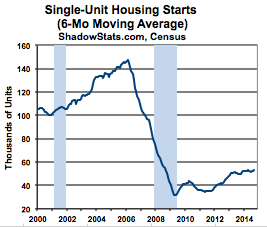
starts and permits - September 2014


Some interesting data sets regarding housing...can anyone say 'continued volatility' with multifamily taking the lead...


U.S. housing starts increased 6.3% in September, driven primarily by multifamily construction.


Wednesday, September 10, 2014


Federal Reserve Chair Janet Yellen has long said she remains focused on the health of the labor market, and in her most recent public comments at Jackson Hole, she said that given the current state of the labor market, there was "no simple recipe for appropriate policy in this context." 

And for Gundlach, one chart makes clear why Yellen's desire to raise interest rates is most likely far less than many assume. 

Wages as a percent of GDP remain near multi-decade lows, and until this trend shows any sign of improvement, Gundlach doesn't think that Yellen will want to do anything with interest rates. 

Gundlach also noted that real wages for the bottom seven deciles of earners had fallen between 2007 and 2014, to which Gundlach said, "It seems tough that with so many workers losing purchasing power on a year-over-year basis, you could raise short-term interest rates."